Chapter 7 of 10
The Lighthouse
Jack flew east over open ocean for most of the day. The distant colony disappeared behind him. By afternoon, there was no land in sight. Only sea. Sky. And Maurice’s map, which Jack had begun consulting less often when he stopped to rest.
This was partly because Jack was becoming more confident. It was mostly because the map was terrible.
Late the following morning, something appeared on the horizon.
At first Jack thought it was a ship. Then a cliff. Then perhaps a very ambitious rock. As he drew closer, he saw a narrow black island rising sharply from the sea. At its highest point stood a lighthouse.
Jack slowed.
After everything he had heard, imagined and crossed an ocean to find, the sight of it made his chest tighten.
The Lighthouse of Exact Reasons.
Jack looked toward me.
“Fine,” he said. “You may have this one.”
I behaved with considerable dignity.
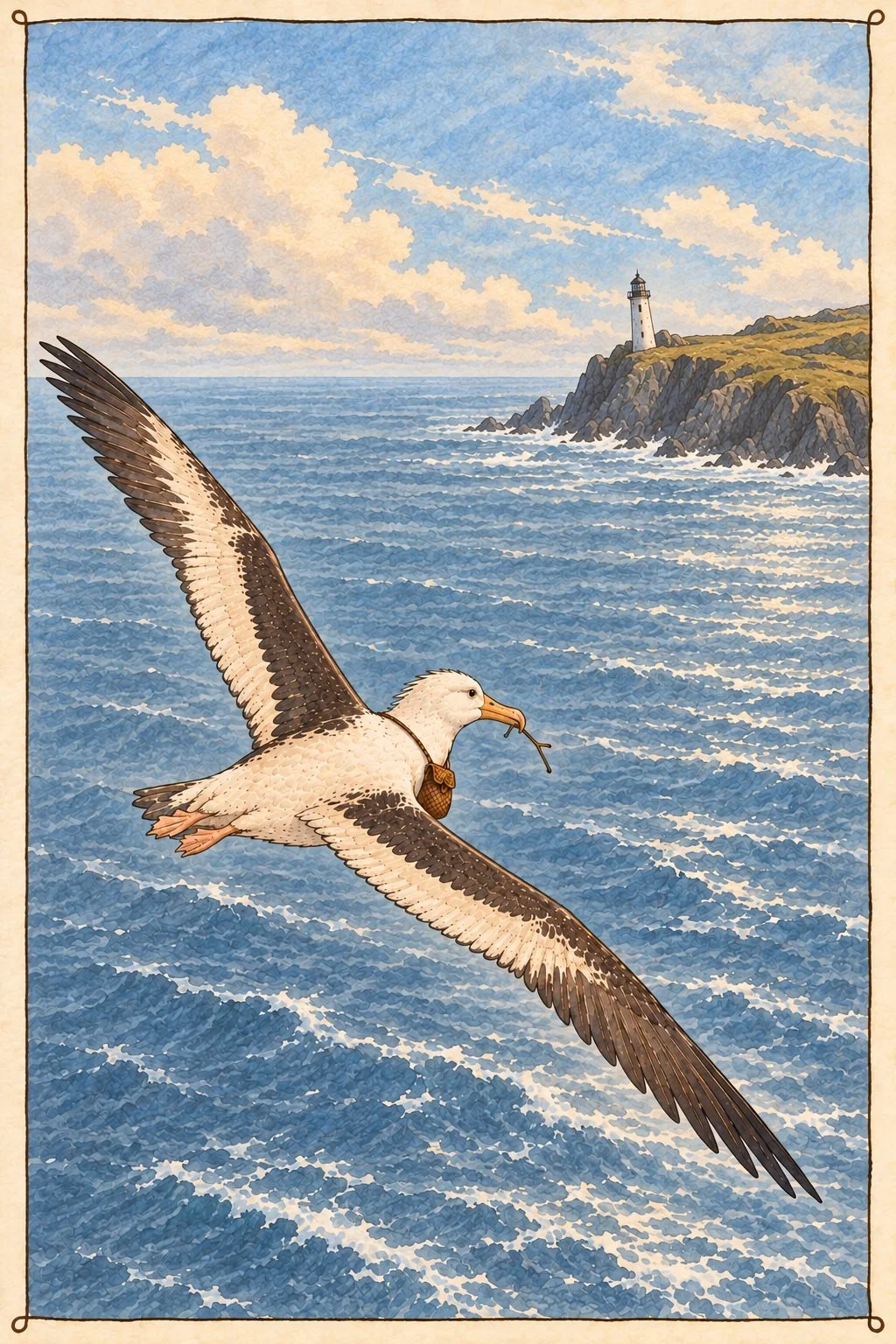
The lighthouse was tall and white and leaned very slightly to the left. This was an instance of architectonic obliquity.
“It leans,” said Jack.
A lamentably unambitious description.
This was not symbolic. It had been built badly.
Around its base sat hundreds of wooden boxes. Some were stacked neatly. Others were not. Papers protruded from several.
One box was labeled:
UNRESOLVED
Another:
MOSTLY RESOLVED
A third:
RESOLVED, BUT NOBODY LIKED THE ANSWER
Jack landed beside it. He was beginning to feel hopeful.
The keeper of the lighthouse was a little blue penguin named Algernon.
Algernon was extremely small. The lighthouse was extremely large. This imbalance did not bother him.
Algernon wore a brass key around his neck, carried a pencil behind one ear and spoke with the grave seriousness of a creature responsible for matters beyond ordinary comprehension.
“State your inquiry,” he said.
Jack slipped off his satchel beside the doorway and put down the twig.
“My mate left me.”
Algernon nodded.
“Common.”
Jack frowned.
“She blamed me.”
“Also common.”
“I came to find out why.”
Algernon sighed.
“Very common.”
Algernon led Jack inside.
The lighthouse contained shelves. Then more shelves. Then ladders leading to additional shelves. Each shelf held boxes. Each box held papers.
Every paper contained an explanation for something. Why a ship sank. Why a tern moved south. Why someone stopped visiting. Why a fish disappeared from a bucket. Why two brothers had not spoken in eleven years. Why an elderly seal refused to sleep anywhere except beneath a red boat.
Jack stared upward.
“You have explanations for all of these?”
“No,” said Algernon.
Jack looked at the shelves.
“Then what are the papers?”
“Attempts.”
Algernon climbed a ladder. Jack waited. Algernon climbed higher. Jack waited longer.
Eventually Algernon disappeared into the shelves. There was a crash. Then silence.
“Are you all right?” Jack called.
“Yes.”
Another crash.
“You don’t sound all right.”
“I am reorganizing.”
Jack heard several papers flutter to the floor. Algernon returned carrying a thick folder.
On the front was written:
PARTNERSHIP DISSOLUTIONS: AVIAN
Jack swallowed.
Algernon opened the folder.
“Possible causes,” he said.
He began reading.
“Fear. Resentment. Unspoken expectations. Old injuries. New desires. Different needs. Poor timing. Misunderstanding. Self-protection. Restlessness. Loneliness inside togetherness. Loneliness outside togetherness.”
Jack interrupted.
“Which one was mine?”
Algernon looked up.
“That is not how this works.”
Jack’s hope dimmed.
“I crossed an ocean,” Jack said.
Algernon nodded sympathetically.
“That is inconvenient.”
“I was told you could give me the exact reason.”
“No one here has ever claimed that.”
“Maurice did.”
Algernon closed his eyes.
“You know Maurice?”
“Yes.”
Algernon sighed.
“Ah.”
Jack understood more from that sigh than Maurice had explained in several days.
Algernon led Jack to the top of the lighthouse.
The lamp rotated slowly. Each time it passed, a white beam crossed the darkening sea.
“What does the lighthouse actually do?” Jack asked.
Algernon looked surprised.
“It helps ships avoid the rock.”
“That’s it?”
“That is quite a useful thing.”
Jack had to admit this was true.
“But what about all the explanations?”
Algernon gestured toward the shelves below.
“Creatures bring them.”
“Why?” Jack asked.
“Because uncertainty makes them uncomfortable.”
Algernon adjusted the lamp.
“They arrive with facts. Memories. Accusations. Regrets. Letters. The occasional feather.”
“And you tell them what happened?”
“We help them look.”
Jack frowned.
“That sounds much less impressive than what Maurice described.”
“Most useful things do.”
Algernon placed the twig beneath the lighthouse beam. It cast a long shadow across the floor.
“What does that tell you?” Jack asked.
“That it is a twig.”
Jack sighed.
“Clementine already established that.”
“She sounds competent.”
“She collects spoons.”
“Competence takes many forms.”
Algernon asked Jack to tell him the story.
So Jack did. Again. But this time something was different.
He told Algernon what Sadie had said. Then what Jack himself had believed. Then what his friends had seen. What Esther had asked. What Beatrice had helped him understand. What Bernadette had shown him. What he had learned from Pip and Celeste.
The story was becoming harder to summarize.
This felt strangely encouraging.
When Jack finished, Algernon said:
“You have several explanations.”
“I want the explanation.”
“There may not be one.”
“There has to be.”
“Why?”
“Because I thought one answer might let me stop asking.”
Algernon nodded.
“Many things happen for several reasons at once.”
Jack disliked this immensely. He had imagined an answer with edges: something he could examine, understand and finally put away. Several possible reasons felt like an invitation to begin searching all over again.
Reality was developing an irritating resistance to simplicity.
Algernon returned to the folder.
“Perhaps Sadie wanted a different life.”
Jack listened.
“Perhaps something you thought was settled still troubled her.”
Jack looked toward the sea.
“Perhaps she believed leaving would make her happier.”
“Which one is true?” Jack asked.
Algernon rested a flipper on the folder.
“These are possibilities. This folder does not know Sadie.”
Jack was quiet.
“What if I never know?” Jack asked.
Algernon closed the folder.
“You already know quite a lot.”
“But not everything.”
“No.”
“What if there isn’t a better answer?”
Algernon considered this.
“Then there isn’t.”
Jack waited for more. None came.
“That’s it?”
“Yes.”
“That seems profoundly unsatisfying.”
Algernon nodded.
“Truth is under no obligation to be satisfying.”
Jack looked toward me. I said nothing. There are occasions when even an author recognizes that improvement would be dangerous.
Jack stood beside the lighthouse window. Far below, waves struck the black rock.
He still wanted Sadie to understand. To tell him he had mattered.
Wanting something, Jack was learning, did not mean your life had to wait for it.
Algernon returned the twig. Jack laid it beside his feet.
“Did I waste my time coming here?” he asked.
Algernon looked offended.
“You crossed an ocean.”
“I know.”
“You met creatures you would never have met.”
“Yes.”
“You learned things.”
“Yes.”
“You ate three dinners with an interesting albatross.”
Jack stared at him.
“How do you know there were three?”
Algernon looked toward the shelves.
“We receive correspondence.”
Jack decided the lighthouse was stranger than he had realized.
Jack stayed until morning. At dawn, the lighthouse beam faded and the horizon turned pale.
Jack looked east. Then west.
For most of his journey, he had been flying toward an answer. Now there was nowhere he needed to go for one. This was unsettling. It was also freeing.
Jack slipped the satchel back over his head. Then he placed the twig in his bill. Opened his wings. And flew back out over the sea.
Not because he had found the exact reason.
Because he no longer believed an exact reason was required.