Chapter 3 of 10
The Harbor
For most of the day, Jack flew above open water. The wind carried him east, then southeast. The island behind him became smaller. Then it became a line. Then it disappeared.
By evening, Jack reached the coast of the mainland. There, tucked inside a rocky bay, was a busy harbor crowded with fishing boats, seabirds and seals.
Jack landed on a stone wall near the water.
I call it: The Harbor of Unsolicited Expertise.
Jack looked at me.
“No.”
You have barely arrived.
“I already dislike the name.”
The harbor was loud. Gulls shouted from rooftops. Shags dried their wings on posts. Seals occupied walkways as though pedestrians were an unfortunate rumor.
And nearly every creature had an opinion.
The moment Jack landed, a shag approached him.
“You’re carrying that twig wrong,” said the shag.
Jack blinked.
“How should I carry it?”
“Differently.”
The shag walked away.
A tern immediately took his place.
“Your posture is the problem,” the tern said.
“What problem?”
“All of it.”
By lunchtime the next day, Jack had received advice from three gulls, two shags, one penguin, a seal with a scar over one eye and a plover who believed nearly every emotional difficulty could be improved through hydration.
No two pieces of advice agreed. This did not reduce anyone’s confidence.
Jack noticed something. The more certain each creature sounded, the more tempted he was to believe them. Sadie had sounded certain too. Perhaps, Jack began to wonder, certainty was not quite the same thing as truth.
This was the harbor’s first useful contribution. He found it annoying. He had hoped someone would simply tell him what to believe. Now he would have to decide whom to trust, including himself.
At the quiet end of the harbor, Jack found a fur seal stretched across the edge of a low stone quay. Her head and shoulders were shaded by a bench; her hind flippers trailed in the water. Her name was Bernadette.
Bernadette had silver whiskers, a dark wet coat and a notch in one ear. She had lived near the harbor for years and refused to explain why.
“I prefer transitional spaces,” she told Jack.
Jack did not know what this meant. Bernadette offered no translation. She said things like that often.
Bernadette opened one eye.
“You look terrible,” she said.
Jack placed the twig beside him.
“Thank you.”
“You’re welcome.”
“That wasn’t gratitude.”
“I know.”
Bernadette yawned.
“What happened?”
“My mate left.”
Bernadette nodded.
“That happens.”
Jack waited.
“That’s all?”
“What else would you like me to say?”
“I don’t know.”
“Good,” said Bernadette. “Knowing that is underrated.”
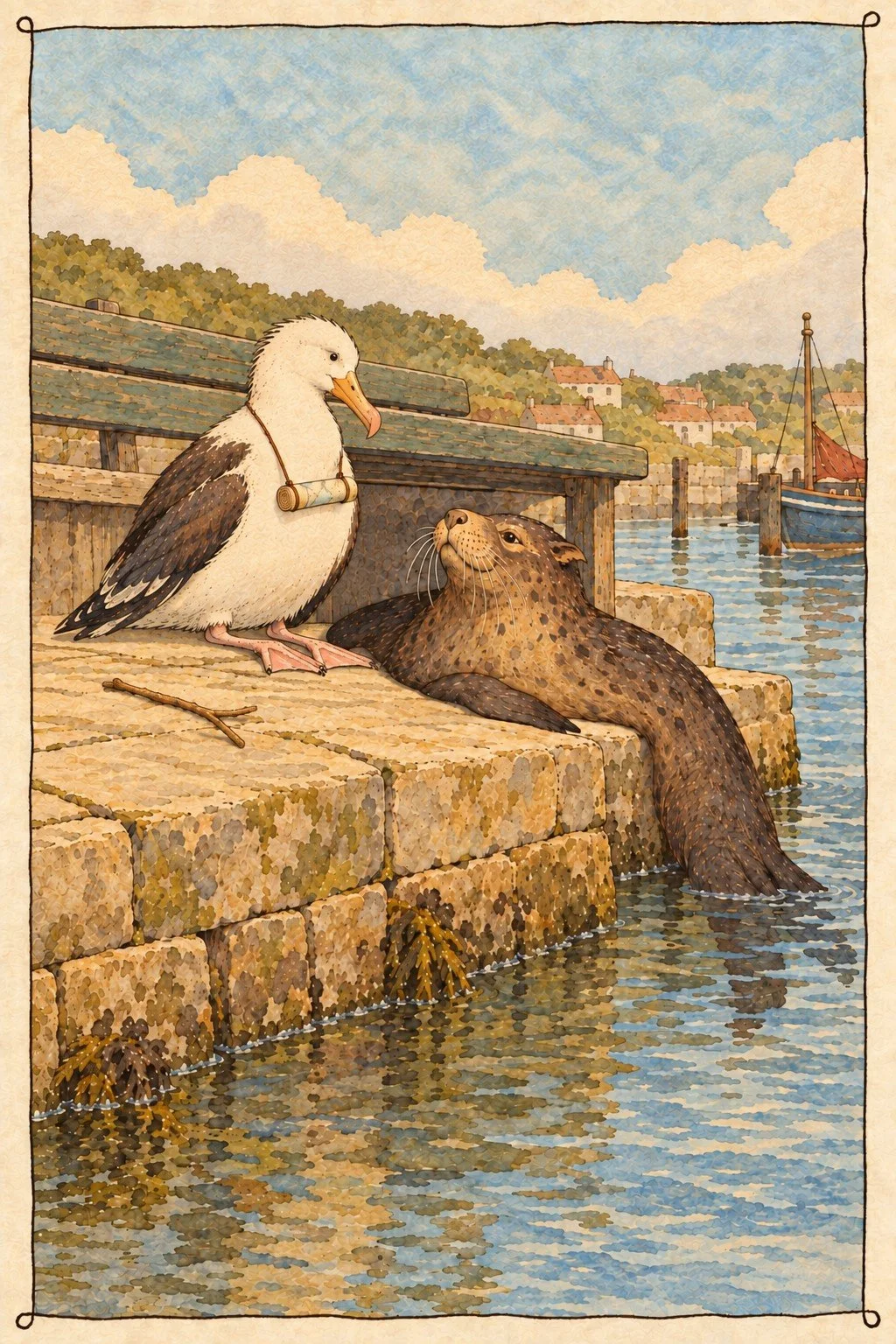
Bernadette did not explain Jack to himself. This made her unusual in the harbor.
She asked whether he was hungry. Jack was. They shared two fish. Bernadette swallowed hers whole. Jack stared.
“Efficiency,” she said.
“You could chew.”
“I could also compose poetry. Neither is required.”
Jack was still deciding whether he had been comforted or merely fed.
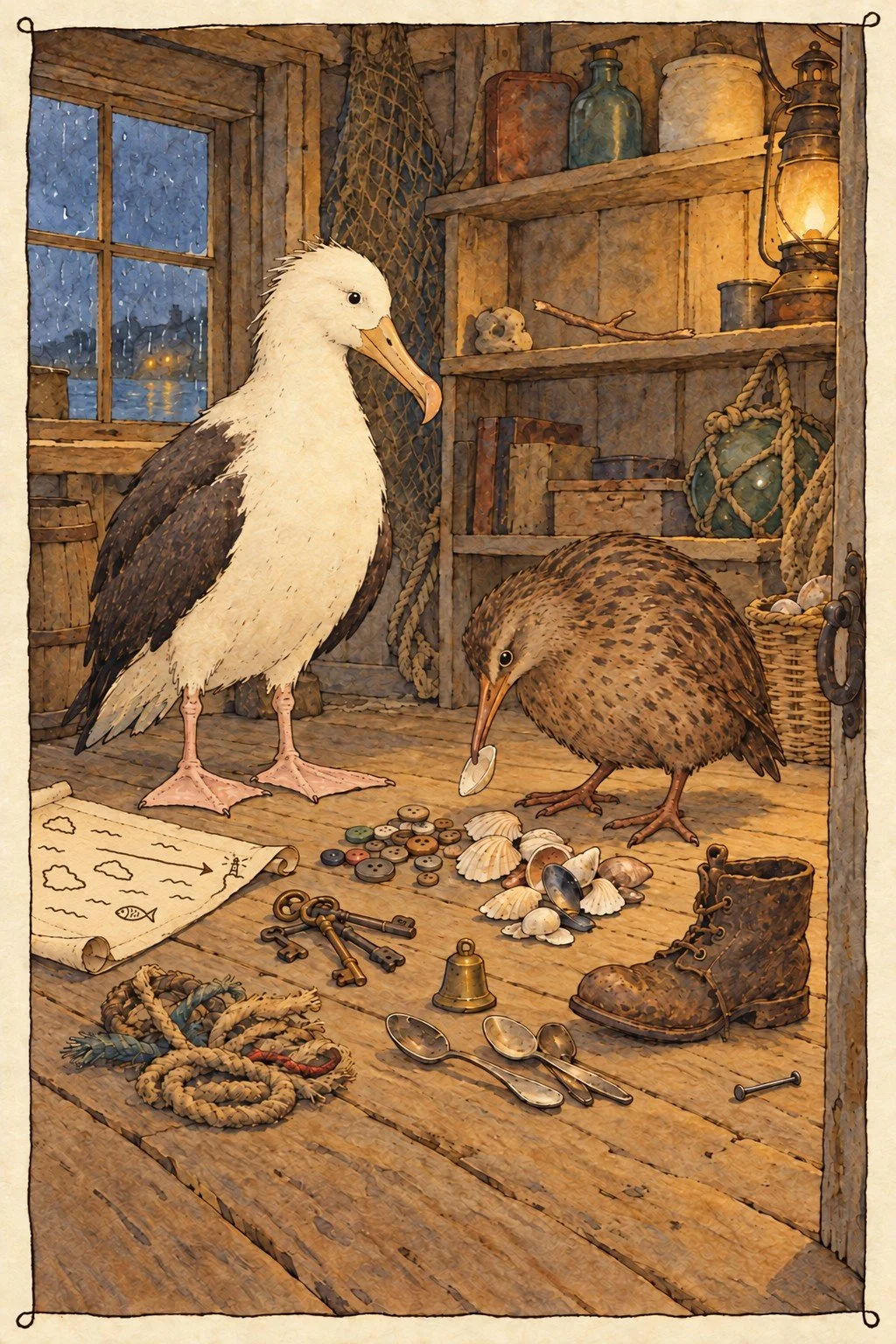
That evening, Bernadette led Jack along the harbor road to an old boathouse. Behind it stood a crooked shed. Inside lived a weka named Clementine. She was round and brown, with striped feathers and bright eyes that followed Jack’s arrival, his twig and the loose nail beside the door, in that order.
Clementine collected things. Buttons. Shells. Keys. Bits of rope. Spoons. A tiny bell. One complete boot. No one knew where the other boot was. Clementine considered this none of their business.
A sign hung above the shed door:
THE MUSEUM OF THINGS PEOPLE SHOULD HAVE WATCHED MORE CAREFULLY
Jack read it twice.
“That is an excellent name,” Jack said.
I was offended.
You object to my place names.
“Yours are trying too hard.”
And this one is not?
“No. This one earned it.”
Jack’s standards were becoming difficult to defend.
Jack unwound the map from his neck and handed Clementine the twig. She examined it.
“This is interesting,” she said.
Jack brightened.
“It is?”
“No. It is a twig.”
Jack’s expression changed.
“But you are carrying it like treasure,” Clementine added.
“It matters.”
“To whom?”
“To me.”
Clementine nodded.
“Then that is different.”
She placed it gently on a shelf. Jack immediately reached for it.
“Give it back.”
Clementine tilted her head.
“You handed it to me.”
“I know.”
“You asked me to examine it.”
“I know.”
“And now you need it back.”
“Yes.”
Clementine smiled.
“Useful.”
“What is?”
“You noticed.”
That night, rain tapped against the shed roof.
Bernadette slept outside because, according to Bernadette, roofs were “emotionally constraining.”
Clementine sorted her collection into four piles: Lost. Left. Stolen. Abandoned.
Jack watched her work.
“What’s the difference?”
Clementine looked up.
“Usually intention.”
Jack was quiet.
“And when you don’t know the intention?” he asked.
Clementine shrugged.
“Then you don’t know.”
Jack disliked this answer.
He had spent months trying to determine exactly what Sadie had meant, felt and intended. He had treated every memory as evidence. Every silence as a clue. Every old conversation as a document requiring further analysis.
Clementine handed him the twig.
“Sometimes,” she said, “you do not get the missing piece.”
Jack looked at it.
“What do you do then?”
“You stop calling the puzzle unfinished.”
Jack was not ready to do that. But the idea stayed with him. This is how many useful ideas behave. They arrive before they are welcome.
Clementine gave Jack a small white shell.
“What does this mean?” Jack asked.
“Nothing.”
“Nothing?”
“It is a shell.”
Jack waited.
Clementine waited longer.
Jack smiled despite himself.
Clementine found him a little woven kelp satchel lined with oilskin, with a cord that fitted around his neck. Jack put the shell and rolled map inside and folded the flap shut. The bag rested against his breast.
He picked up the twig in his bill.
For the first time in months, he carried something simply because he liked it.
The following morning, Jack left the harbor. Bernadette accompanied him. Jack flew low above the coastline while Bernadette swam beneath him, surfacing every few minutes.
To Jack’s left was land. To his right was open sea. For two days, they traveled south along the coast.
Their conversations occurred in inconvenient installments. Jack shifted the twig to the corner of his bill for each one.
“Are we companions now?” Jack called down when Bernadette surfaced.
“No,” Bernadette replied.
“We are traveling together.”
“Yes.”
“That sounds like companionship.”
Bernadette disappeared beneath the water.
At a rocky inlet, Bernadette stopped. Jack circled above her, then landed on a low shelf of stone.
“This is where I turn back,” she said.
Jack felt unexpectedly disappointed.
“You’re leaving?”
“Yes.”
“When will I see you again?”
“I don’t know.”
Bernadette looked at him.
“Jack, leaving and abandoning are not the same thing.”
Then she slid into the water.
Jack watched her swim away. She had told him she was leaving. She had said goodbye. She had not blamed him.
The difference mattered.
Jack remained on the rock for a while. He realized something unpleasantly precise. Sadie’s departure hurt because he had loved her. But the way she left had created another wound beside the first.
One was loss. The other was abandonment.
Sadie had spoken of his failures, but not of her own part in what had gone wrong. There had been no apology and no word of thanks for the years of love, support and companionship he had given her. He had lost their life together. He had also been left wondering whether the good in it had counted for anything.
Understanding the difference did not heal either wound. But it gave Jack better names for them.
And sometimes naming a pain does not make it smaller. It simply makes it less mysterious.