Chapter 4 of 10
Seven Nights
Jack left the inlet and flew farther south along the coast. Near evening, he turned away from the mainland and crossed a narrow stretch of open sea toward a small, forested island. Dark trees covered its slopes. A rocky ridge ran down the center.
No buildings were visible. No boats. No sensible reason to go there.
I call it: The Island Where the Wind Is Not to Blame.
“No,” said Jack.
The name is thematically sophisticated.
“It sounds like a lecture.”
That is not necessarily a criticism.
“It was intended as one.”
The island was inhabited mostly by nocturnal birds. During the day, it seemed almost empty. At sunset, it became lively. Birds emerged from burrows and trees.
They gathered beneath the forest canopy. They talked. They listened. They occasionally did things Jack found deeply embarrassing.
Their leader was a kakapo named Beatrice. Beatrice was large, green and smelled faintly of moss. She had never hurried. Not once.
This was not philosophy.
She was simply slow.
Beatrice greeted Jack after dark. Jack set the twig on the moss between his feet.
“You have come to unlearn,” she said.
“I came because Bernadette told me this island might help.”
“That too.”
“What am I supposed to unlearn?”
Beatrice shrugged.
“If I knew that already, your visit would be disappointingly short.”
Jack looked at me.
“She talks like you.”
I was flattered.
“You should not be.”
For seven nights, Jack stayed on the island. During the day, he rested beneath the trees. At night, Beatrice gave the visitors peculiar assignments.
They walked familiar paths backward. They sat silently beside creatures they disliked. They shouted old beliefs into sea caves. One evening, they danced badly around a stump.
Jack objected to this last exercise on both aesthetic and philosophical grounds.
Beatrice ignored him.
She tucked a fern frond into the stump. Jack tried three steps, caught his own foot and lurched sideways.
“Too elegant,” said Beatrice.
The stump remained the best dancer.
On the third night, Beatrice asked every creature to name something they had learned long ago. A fear. A habit. A belief. A way of protecting themselves.
One bird said she had learned never to ask for help. Another had learned to leave first. A third believed that being needed was the safest way to be loved.
Then it was Jack’s turn. He thought for a long time.
“When someone I love pulls away,” Jack said, “I try harder.”
Beatrice nodded.
“And does trying harder bring them closer?”
Jack looked at the ground.
“Sometimes.”
“And when it doesn’t?”
“I try harder.”
Jack understood immediately why this mattered. He also wished he did not.
He had spent years treating Sadie’s distance as a problem he could solve with enough effort, enough patience or enough love.
Beatrice did not tell him this was foolish. She asked another question.
“Why did you believe her distance was yours to fix?”
Jack had no answer.
This irritated him for most of the following day.
On the fourth night, Beatrice asked Jack:
“What did Sadie learn?”
Jack frowned.
“How would I know?”
“Exactly.”
Jack waited.
Beatrice continued.
“You can understand another creature’s patterns. You cannot crawl backward into her childhood and live it for her.”
Jack waited for another question. Beatrice offered none.
Still, Jack began thinking.
Sadie had always been independent. She needed little from others. She admired self-sufficiency.
Once, in fog so thick Jack could not see the tip of his own wing, she had flown close enough for him to follow her home.
When feelings became difficult, she often became quieter. When life felt uncertain, she made plans. When Jack asked what was wrong, she sometimes looked toward the horizon.
Jack had once understood these qualities mostly as strength.
Now he wondered whether some of them had also begun as protection.
Beatrice listened. Then she said:
“Some birds learn very young that the safest wing is their own.”
Jack looked at her.
“They become excellent flyers,” Beatrice continued. “The difficulty comes later, when someone asks them to land.”
Jack was quiet. For the first time, he imagined that Sadie’s distance might not have begun with him.
This did not make what happened hurt less.
But it made the hurt less personal.
The next night, Jack asked Beatrice a question of his own.
“If Sadie learned to protect herself that way, does that mean I shouldn’t be angry?”
Beatrice shook her head.
“No.”
“But if that helps me understand her—”
“Understanding is not absolution.”
Jack waited.
“An explanation can lighten a mystery,” Beatrice said, “without lightening the wound.”
Jack looked toward the dark trees.
He thought about Sadie. About what she might have learned long before she knew him. About how those lessons may have helped her survive. And about how those same lessons may have hurt him.
Both could be true.
On the sixth night, Beatrice asked Jack another question.
“Do you think you were a good mate?”
Jack hesitated.
“I think so.”
“That was not very convincing.”
“I made mistakes.”
“So do trees.”
Jack looked at her.
“Trees?”
“They grow crooked. Lose branches. Lean the wrong way. Still trees.”
Jack considered this.
Beatrice continued.
“Making mistakes does not require you to become the mistake.”
Jack thought about the years with Sadie.
He remembered arguments. Times he had misunderstood her. Times he had spoken when he should have listened. Times he had listened when perhaps he should have spoken.
There were things he would do differently.
This was true. But other things were true too.
He had loved her. He had stayed. He had tried. He had built a life beside her with sincerity.
He told Beatrice these things. When he began to explain why none of them counted for very much, he stopped.
For a long time, Jack had confused having things to improve with having caused the ending.
They were not the same.
“So I wasn’t responsible?” Jack asked.
Beatrice shook her head.
“I did not say that.”
Jack frowned.
“You are very difficult to talk to.”
“So I am told.”
Beatrice settled more deeply into the moss.
“You were responsible for your part.”
“And Sadie?”
“For hers.”
“What if I keep trying to do hers?”
Beatrice was silent for a while. Jack had learned that Beatrice’s silences were rarely empty. Eventually she said:
“Then notice when you begin. You need not finish.”
Jack did not like this.
He wanted Sadie to understand. He wanted her to see the hurt she had caused. He wanted her to acknowledge that their life had contained goodness. He wanted them to talk about what each of them might have done differently.
These did not seem like unreasonable desires. They were not.
Unfortunately, reasonable desires are not guarantees.
“What if she never says she is sorry?” Jack asked.
Beatrice looked at him.
“What would her apology give you?”
Jack answered immediately.
“Proof that she understands.”
“And if she never understands?”
Jack said nothing. Beatrice waited.
“What then?” Jack finally asked.
“That,” said Beatrice, “is a question you may have to live before you can answer it.”
Jack sighed.
“I preferred the backward walking.”
On the seventh night, the birds gathered near the top of the island. They stood on a grassy ridge above the sea. Far below, waves broke against black rock. Beyond them was the open ocean.
No mainland was visible. Only darkness, water and a thin line of moonlight. The scene was, if I may say so, exquisitely liminal.
Jack turned toward me.
“No.”
I had not even finished.
“You described it as liminal.”
I did.
“That word should require a permit.”
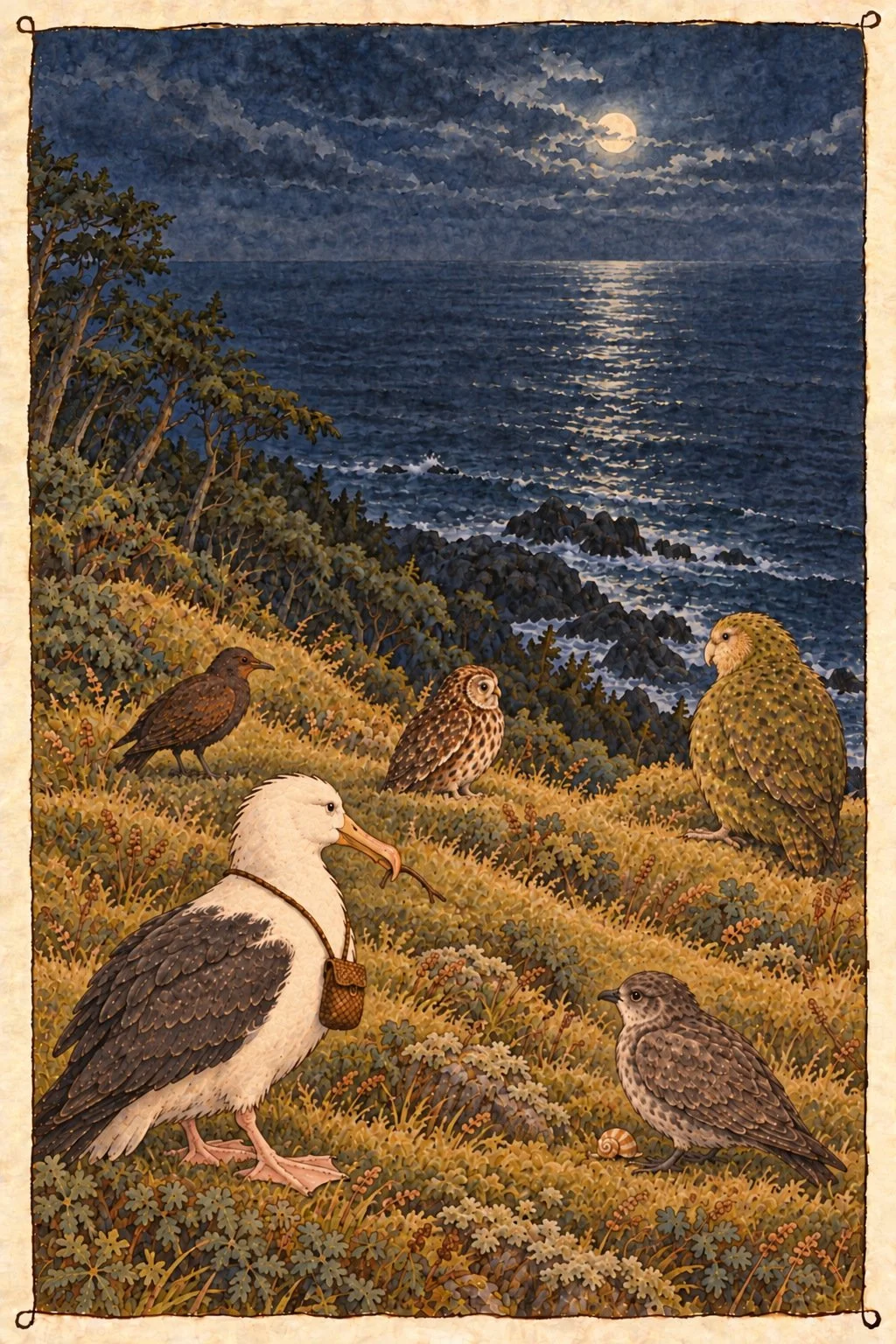
Beatrice asked each visitor what they were taking with them. One bird said courage. Another said patience. A third said she planned to take several snacks. Beatrice approved of this.
Then it was Jack’s turn. He set the twig between his feet and thought carefully.
“I think I’m taking fewer answers.”
Beatrice smiled.
“And?”
“Better questions.”
Beatrice nodded.
Jack looked down at the twig between his feet.
“And apparently this.”
He picked it up.
Before Jack left, Beatrice walked with him to the edge of the forest.
“You still miss her,” she said.
“Yes.”
“You may for a long time.”
Jack nodded.
“You may understand Sadie better and still hurt.”
Jack nodded again.
“You may forgive things and still wish they had happened differently.”
Jack looked toward the sea.
“And I may never get everything I want from her.”
“No.”
Jack sighed.
“That part seems poorly designed.”
Beatrice brushed a strand of moss from her feathers.
“It is,” she said.