Chapter 2 of 10
The Birds Who Stayed
Jack’s friends began to worry. This happened gradually. At first, they assumed Jack needed time. Then they assumed he needed more time.
Then they began to suspect that time, left entirely to its own devices, was doing a rather poor job.
So they came to see him.
They brought fish. They brought stories. They brought news from parts of the island Jack had stopped visiting.
Mabel, an albatross with broad gray shoulders and one enormous foot, sat beside him for an entire afternoon and said almost nothing. She had tucked a fish beneath the foot in case he became hungry.
Hugo had a feather sticking straight up from his head and enough news to keep it there. He talked so much that everyone else said almost nothing.
Iris, whose thin dark eyebrow made even her compliments look suspicious, announced that Sadie had made a terrible mistake.
Jack did not find this helpful.
Sadie was still Sadie.
He still loved her.
A heart does not always reorganize itself merely because new information becomes available.
Sometimes Mabel asked how he was doing.
“Fine,” Jack said.
He was not fine. He was not even particularly close to fine. But fine is a useful word. It allows you to answer a question without having to open all the rooms behind it.
Jack turned toward the author. “You’re doing it again.”
Doing what?
“Making simple things sound important.”
They are important.
“They’re rooms now?”
Metaphorical rooms.
Jack sighed.
“Continue.”
His friends continued coming. This mattered. They could not explain Sadie or make Jack stop hurting. They simply kept arriving.
There are times when this is the most useful thing one creature can do for another.
When Jack could not hold himself up, his friends did not carry him away.
They stood close enough that he could lean.
They also reminded Jack of things he had forgotten.
Mabel reminded him of the storm in which he had flown beside an injured bird until it reached shore. Hugo remembered the young albatross Jack had taught to catch a difficult current. Iris listed the fish he had shared. The promises he had kept. The times he had shown up.
Not because Jack had never made mistakes. He had. Everyone had. Even the author.
“Especially the author,” said Jack.
That seems unnecessary.
“It seems accurate.”
His friends did not tell Jack he was blameless.
Good friends rarely need to lie in order to be kind.
They simply reminded him that Sadie’s description of him was not the only description available. When she left, she had spoken only of what Jack lacked and what he had done wrong. She had not spoken of his kindness, his patience, or the years of love and companionship they had shared. His friends remembered those things, too.
This was confusing.
Jack had spent so much time examining what was wrong with him that he had forgotten to ask what might still be right.
An albatross can become so busy investigating his flaws that he mistakes the inventory for the whole bird.
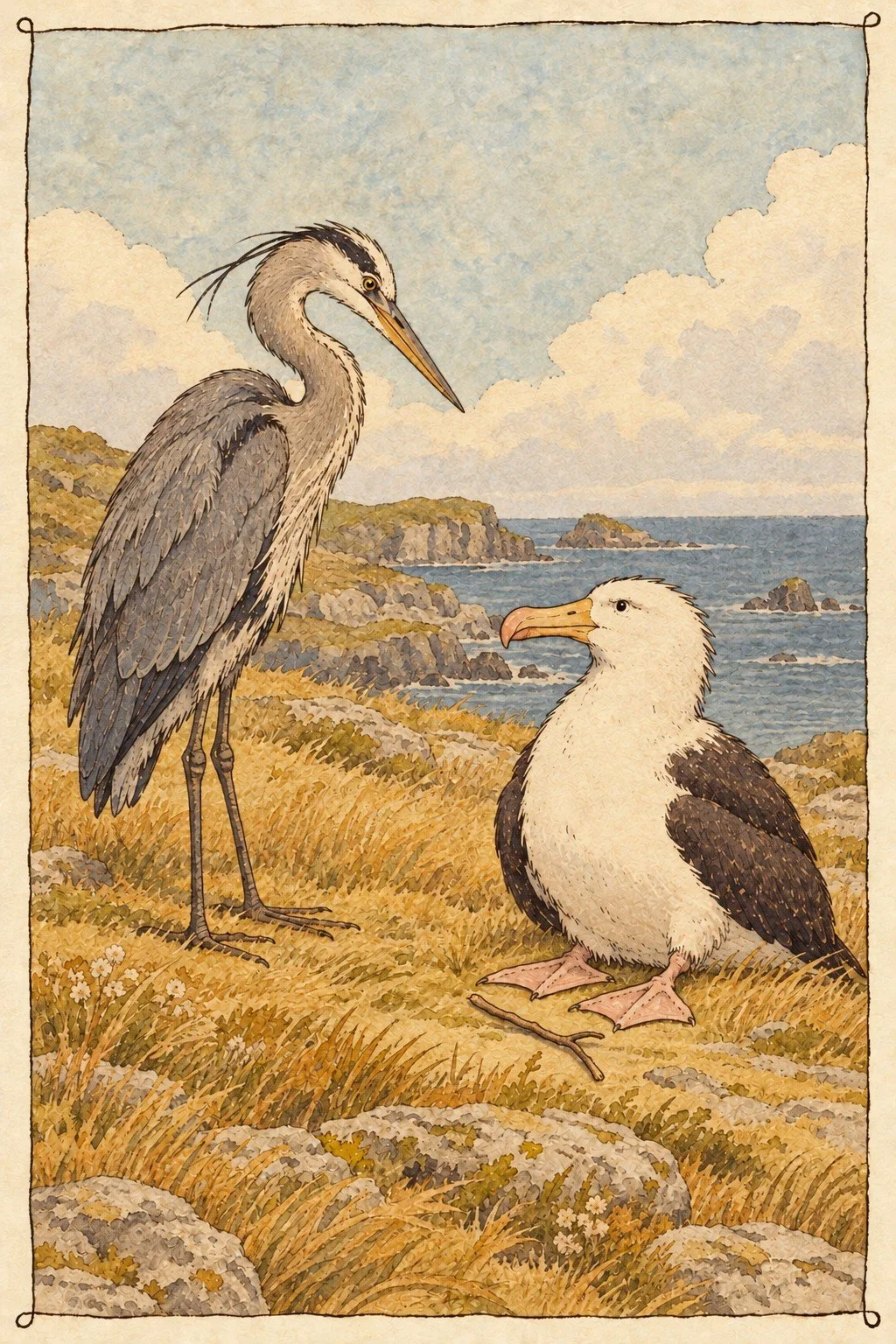
One morning, an old heron named Esther arrived. She was tall, slate-gray and folded into so many angles that Jack suspected she had spare knees.
She was quiet and had the irritating habit of listening all the way to the end of a sentence. Jack distrusted this immediately.
“What do you want?” he asked.
The heron looked at the twig in his bill. Jack put it down.
“To ask you a few questions.”
Jack picked up the twig.
“No.”
The heron waited.
Jack put it down again.
“What questions?”
“Why did Sadie leave?”
Jack began answering.
He told Esther what Sadie had said. He explained his mistakes. He described his shortcomings. He listed several things he should have done differently.
The heron listened.
When he finished, she asked:
“Which of those things do you believe?”
Jack stared at her.
“All of them.”
“That was a very quick answer.”
Jack did not like the heron.
This is not entirely true. Jack did not like the questions.
There is a difference.
People frequently dislike the messenger when the message has arrived without sufficient padding.
“People?” Jack asked.
Birds too.
“Better.”
Thank you.
Jack began meeting Esther regularly. At first, he did this because his friends suggested it. Then he did it because the heron kept asking questions that followed him home.
Some questions are rude that way.
“Were you a good mate?” the heron asked.
“Sometimes.”
“Were you a bad mate?”
“Sometimes.”
“Did you make mistakes?”
“Yes.”
“Did Sadie?”
Jack paused.
“Yes.”
The heron nodded.
“Good. We are making progress.”
“I don’t feel better.”
“I did not say you would.”
Jack had expected healing to feel like improvement. Instead, it often felt like confusion. The more he learned, the less certain he became.
This bothered him.
Sadie had sounded so certain. Jack missed knowing what to believe, even when what he had believed was painful.
Esther also noticed the twig.
“Why do you carry it?” the heron asked.
“It was from our nest.”
“I know.”
“It reminds me of what we had.”
“I know.”
“It matters.”
“I did not say it didn’t.”
Jack looked at her suspiciously. The heron had a way of leaving sentences unfinished until Jack wandered into them himself.
He disliked this tremendously.
“Does carrying it help?” she asked.
Jack looked at the twig.
Sometimes he thought it did. Sometimes it made him sad. Sometimes he forgot he was carrying it at all.
People become accustomed to many things that are still plainly in the way.
Jack looked toward me.
“Was that yours?”
Yes.
“It’s good.”
Thank you.
“Don’t make a thing of it.”
I had no intention of doing so.
I made a small note in the margin.
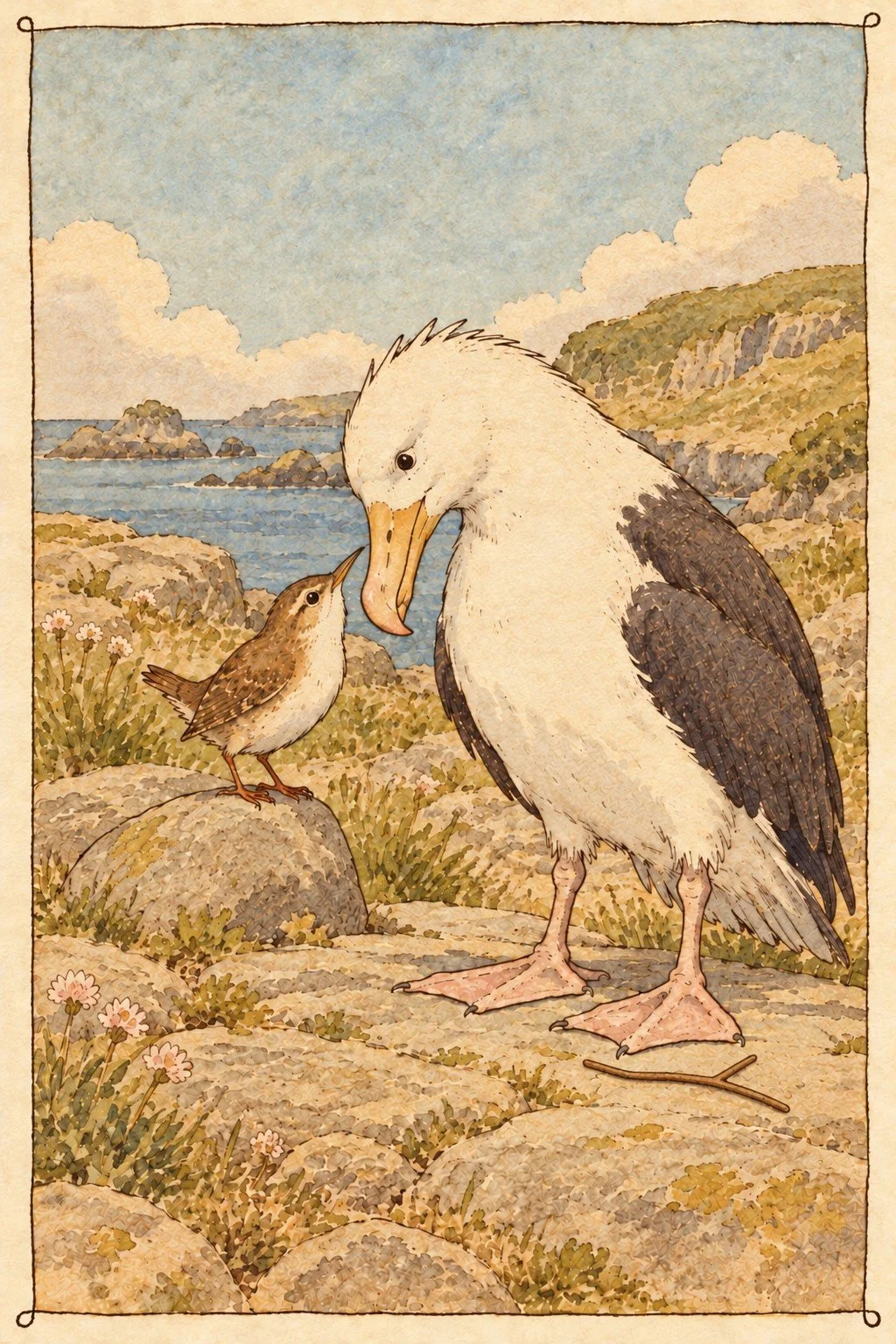
Around this time, Jack also visited a very practical little bird named Tilda, who knew about sleep, food, wings and exhaustion.
She had a round brown body, a white throat and tiny quick feet. She circled Jack twice, then stood on a pebble to examine his face.
“You are tired,” she said.
“I am grieving.”
“You can be both.”
“I don’t sleep well.”
“I noticed.”
“How?”
“You fell asleep while I was examining you.”
Jack had no memory of this.
Tilda suggested food, rest, movement and several other profoundly uninteresting things. Jack was disappointed. He had hoped for a cure.
There was no cure.
This is one of the less convenient facts about heartbreak.
There are treatments. There are practices. There are friends.
There are mornings when getting out of the nest counts as an accomplishment. There are afternoons when you suddenly laugh and then feel guilty for having done so. There are nights when you think you are beginning to recover and mornings when you are quite certain you have learned nothing at all.
Healing, unfortunately, is not known for its administrative efficiency.
Jack approved of this sentence.
He did not say so.
Slowly, things changed.
Not dramatically. Jack did not wake one morning transformed. There was no inspirational sunrise. No choir of seabirds. No sudden understanding of the universe.
He simply began doing small things again.
He flew farther. He visited friends. He listened to the whales. He noticed the grass moving in the wind.
One afternoon, he laughed.
The sound startled him.
And still, he carried the twig.
This is important.
Understanding why you carry something does not mean you are ready to put it down.
“I could have told you that,” said Jack.
You did.
“When?”
Much later.
“Then technically I had not told you yet.”
This is one of the difficulties of being an author.
“You know what happens before everyone else?”
Exactly.
“That sounds unbearable.”
It has its burdens.
Jack rolled his eyes.
Then, one afternoon, a gull arrived with information. Gulls often arrive with information. Whether the information is useful is another matter entirely.
This particular gull landed beside Jack, glanced at the twig and said:
“I know what you need.”
Jack had recently developed a healthy suspicion of creatures who began conversations this way.
“What?”
“Answers.”
Jack looked up.
The gull puffed out his chest.
“There is a lighthouse far beyond these islands,” he said. “A lighthouse where they can tell you the exact reason anything happened.”
Jack looked at the twig.
“Anything?”
“Anything.”
Esther, who happened to be standing nearby, closed her eyes. This was the heron’s preferred method of expressing skepticism.
“Could they explain why Sadie left?” Jack asked.
The gull nodded.
“Precisely.”
I have chosen to call this place The Lighthouse of Exact Reasons.
“No,” said Jack.
No?
“That is not what the gull called it.”
It is clearer.
“It is pretentious.”
It has narrative resonance.
“It has capital letters.”
Those are not mutually exclusive.
Jack looked toward the reader.
“You see what I have been dealing with.”
Now he was involving you. I considered this a troubling development.
Jack did not leave immediately.
Stories often make departures look instantaneous. A decision is made. A noble creature turns toward the horizon. A gust of wind rises at exactly the correct moment. Then off he goes.
Actual departures involve considerably more standing around.
Jack spent three days deciding what to take. In the end, he decided on the twig.
“Austere,” I would call this.
“You mean unprepared,” said Jack.
We will permit both interpretations.
The gull’s name was Maurice.
Maurice had one dark feather in the wrong place, a voice that carried farther than necessary and absolute confidence in information he had only recently acquired.
Maurice knew many things. Or, more accurately, Maurice had heard many things and promoted them quickly.
“There is a difference,” said Jack.
A considerable one.
Maurice did not recognize it.
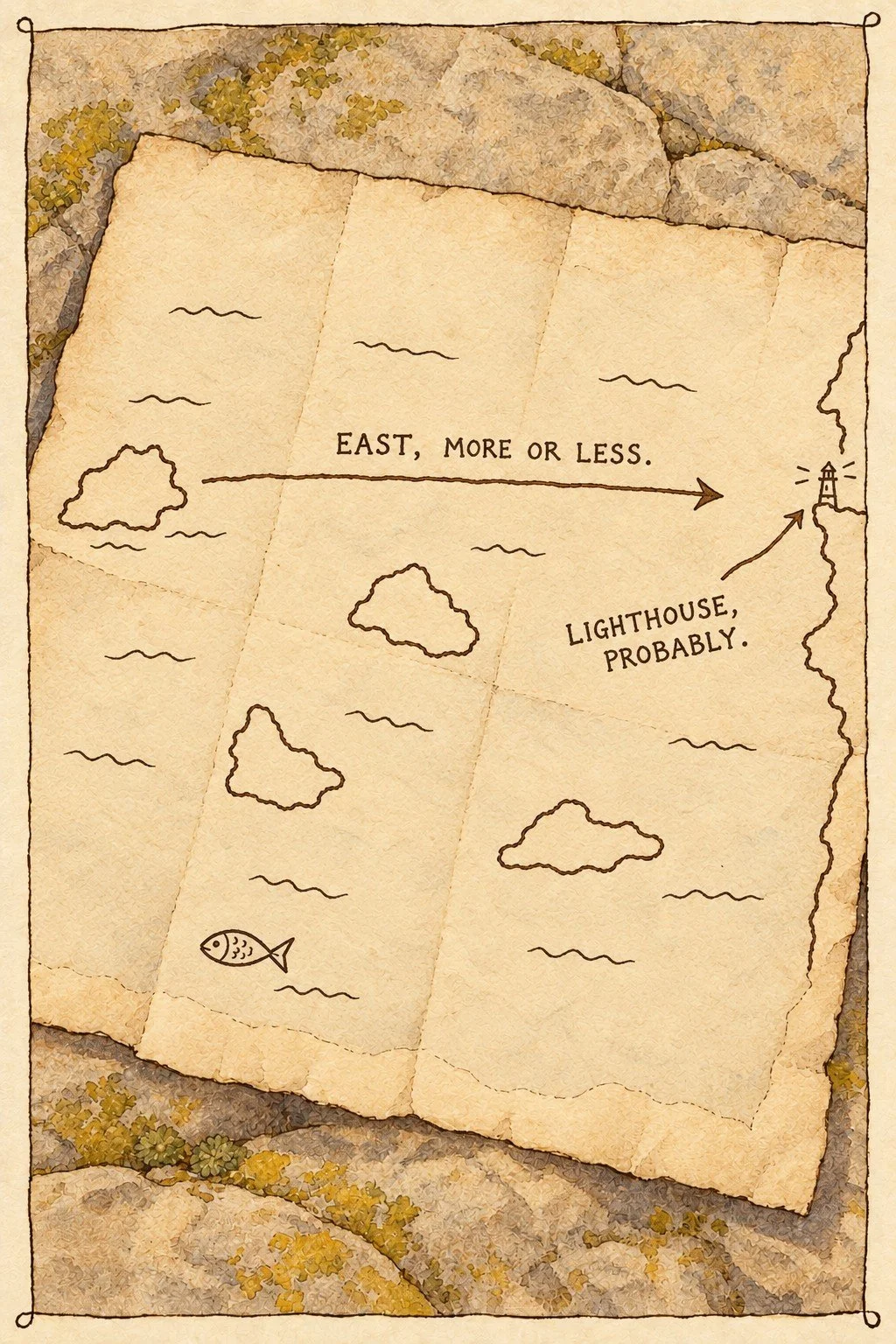
Maurice drew Jack a map. This was generous. It was also unfortunate.
The map showed Jack’s island, several stretches of open ocean, a distant coastline and three islands of uncertain proportion.
One arrow said:
EAST, MORE OR LESS.
Another said:
LIGHTHOUSE, PROBABLY.
There was also a fish.
Jack studied the map.
“Why is there a fish?”
Maurice shrugged.
“I like fish.”
This was the most defensible part of the map. The remaining features exhibited an exuberant disregard for topographical veracity.
“You mean it was wrong,” said Jack.
Wrong is such a small word for so expansive an achievement.
Maurice rolled it tightly and tied it with a soft cord that Jack could loop around his neck. The little roll rested against his breast.
The twig remained in his bill.
The next morning, Jack climbed to the high western ridge of his island. Behind him were the nest, the cliffs, his friends and every path he knew. Ahead of him was open ocean. No land. No familiar rocks. Only wind and water.
This was, in literary terms, the threshold of a profound existential—
“Don’t,” said Jack.
Don’t what?
“Turn standing on a hill into philosophy.”
He was standing on the precipice of transformation.
“He was standing on a hill.”
Both statements may be true.
Jack opened his wings and flew out over the sea.