Chapter 1 of 10
The Nest
Before we begin, something must be made perfectly clear. This is an important story.
Not merely an entertaining story. Not merely a story about a bird, an ocean and a rather ordinary piece of wood.
“A twig,” said Jack.
Yes. A significant twig.
“It was a twig.”
A significant twig. This is a story about loss. A story about love. A story about friendship. A story about the astonishing capacity of a creature to reconstruct himself after the complete and unexpected rearrangement of his emotional existence.
“Did you enjoy writing that last sentence?”
Yes. Yes, I did.
Before we meet Jack, you must understand three things about albatrosses.
The first: Albatrosses are among the greatest travelers in the world. They cross enormous oceans. They ride invisible rivers of wind. They visit places so distant that most creatures cannot imagine them.
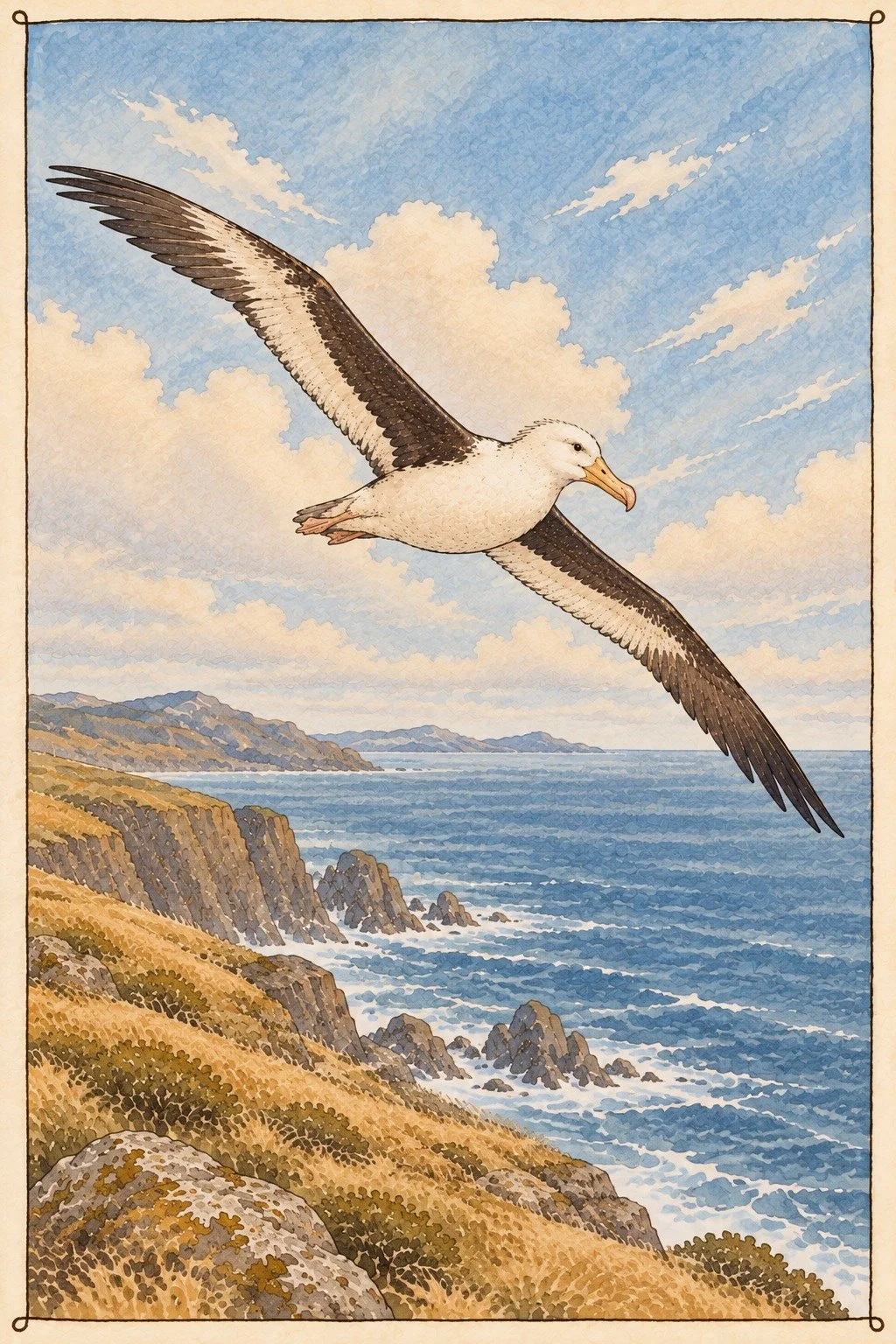
The second: Albatrosses are magnificent in flight. Their wings are enormous. Their movements are graceful. They appear to have been designed by someone who understood beauty.
On land, however, things become slightly more complicated.
A flying albatross is poetry. A walking albatross is poetry in clown shoes.
“I do not wear shoes,” said Jack.
It was a metaphor.
“A poor one.”
The third: Albatrosses are often associated with lifelong partnerships. This is because albatrosses choose mates.
They return to the same places. They learn one another’s habits. They build nests. They raise young. They become part of each other’s rhythms. Humans, who enjoy assigning meaning to everything, have decided this makes albatrosses symbols of devotion and commitment.
“I have no desire to be a symbol,” said Jack.
That’s immaterial to the story.
“I thought this was my story.”
Yes, I suppose it is.
Jack lived on a remote island in the southern ocean that stretched beneath enormous skies. Its western cliffs rose sharply above dark waters where waves arrived with tremendous enthusiasm. Its hills were covered with golden tussock grass that bent and swayed whenever the wind passed through. There were narrow beaches made of smooth stones. Cold streams. Hidden coves. And hundreds of places where a bird could explore and delight in the world around him.
Which Jack often did.
The island was home to many creatures. Albatrosses nested among the tussock grass. Seals stretched across broad stones beside the surf. Butterflies moved like loose flecks of sunlight between the stems, and small birds stitched their calls through the wind.
Even the narrow cracks in the rocks had occupants: beetles, sheltered grasses and tiny lives Jack noticed when he stopped to look. The smooth stones held the sun’s warmth after the light had moved on. Along the shore, darker rocks shone beneath each returning wave.
Jack was not the largest albatross. He had white feathers, dark wings and a small untidy patch at the back of his head that no amount of grooming quite persuaded. He was not the kind of bird who entered a gathering and caused everyone to whisper: “Who is that magnificent creature?”
But Jack was kind. He showed up when others needed him. He was present. He appreciated the little things, like the swaying grass or the sound of the whales that visited the island.
And he knew how to love. And he loved Sadie.
Sadie was extraordinary. Her dark wings folded neatly against her pale sides, and she lifted her beak into the wind as though listening to something the other birds had missed.
She was intelligent. She was steady. She was ambitious. She could remember migration routes that other birds had forgotten. She could sense approaching storms. She could create a plan for almost anything.
Sadie believed the world could always become better. Once, when Jack was ill, she had brought fish to the nest and rearranged the grass until the wind could not reach him. This was one of the things Jack loved about her.
Sadie also loved the horizon.
She did not simply look at it. She studied it. She wondered what existed beyond it. She believed there was always something more to discover.
Jack admired this. He loved that she dreamed. He loved that she was brave enough to fly farther than other birds.
Sometimes, though, Jack wondered if Sadie was so focused on what was out there that she forgot to notice what was beside her.
Jack loved Sadie in the quieter way.
He loved the sound of her voice. He loved the way she looked at the sky. He loved the feeling of seeing her return after a long journey.
Every time Jack saw Sadie, something inside him lifted. A small spark. A little happiness. A feeling that said: There you are.
Every time he saw Sadie, Jack’s countenance acquired a positively beatific aspect.
“Could you simply say I was happy?” Jack asked.
No.
“Why not?”
Because happy is ordinary.
“This is a story about a bird.”
Exactly.
“And birds do not require complicated descriptions of happiness.”
Perhaps not. But even though this is your story, I am the author.
“Yes, I suppose you are.”
For many years, Jack and Sadie were mates. They traveled together. They returned to the same island. They built a nest.
The first thing Sadie placed in their nesting spot was a small crooked twig. She tucked their first strands of grass beneath it to stop the wind taking them, then held it down with her foot while Jack brought more.
“We’ll start with this,” Sadie said.
It was not beautiful. It was not valuable. It was simply there when they needed it.
Which is true of many important things.
Then, one morning, Sadie left.
There was no storm. No dramatic wave. No warning from the sky. The world did not have the courtesy to become unusual simply because Jack’s world had changed.
The sun rose. The wind blew. The ocean continued doing what oceans do.
Sadie told Jack she was leaving.
Not someday. Not after more discussion. Not after they worked through the difficult parts. She had already decided.
Jack asked questions. Sadie answered. But her answers were not invitations. They were conclusions.
She told him what she thought had gone wrong and what she believed he needed to understand.
Jack listened.
Because when someone you love tells you that you are the reason they are leaving, your first instinct is often not to argue.
Your first instinct is to search.
You search your memories. Your mistakes. Your conversations. You search for the moment when you became the bird someone else described.
When someone hands you a story about yourself, you may accept it simply because you are too upset to write your own.
Sadie flew away. And Jack remained. With the nest. With the memories. With the questions.
And with the twig. The smallest piece of something that had once felt permanent.
For a long time afterward, Jack carried Sadie’s words with him everywhere. Some belonged to that morning. Others came from difficult years in which he had begun measuring himself mostly by what disappointed her. He had stopped liking the bird he saw that way.
He carried them while flying. He carried them while eating. He carried them while trying to sleep.
Eventually, he realized he was carrying something else too.
The twig.
At first, Jack was stunned that Sadie left so abruptly. Then he was sad. Then he was angry. Then he felt guilty for being angry. Then he wondered if being angry proved Sadie had been right. And then he was sad again.
Grief is a strange companion. It arrives without invitation and sits heavily in the chair. In time, you wonder whether it’s only a guest.
“We don’t have chairs. We have nests,” said Jack.
Yes, but I’m telling this story to a human.
“I’m interested in accuracy.”
I’m interested in telling this important story without being interrupted.
Jack stopped traveling far. He stopped exploring. He stopped laughing.
He carried the twig everywhere.
This was difficult. A twig is not designed to help someone through heartbreak. It cannot offer advice. It cannot make tea. It cannot say: “Jack, perhaps today would be a good day to leave the nest.”
Jack could manage a few words with it held in the corner of his bill. Long conversations were easier with it on the ground.