Chapter 6 of 10
Making Room
Jack reached the distant coast just before sunset. After days over open ocean, land felt almost extravagant.
There were cliffs. Trees. Streams. Birds everywhere. And, most importantly, places where one could stand without bobbing.
Jack landed on a broad grassy shelf above the sea. He immediately tripped over a root.
No larger meaning should be assigned to this.
“You’re learning,” said Jack.
The coast was home to a large colony of seabirds. Albatrosses lived there. So did penguins, petrels, gulls and several creatures Jack could not immediately identify and was too polite to ask about.
The colony was busy. Birds arrived. Birds departed. Birds nested. Birds did not nest. Birds shared food with other birds and then flew in entirely different directions.
Jack found the whole scene confusing.
A small penguin approached him carrying a stack of papers. Her name was Millicent.
Jack lowered his satchel and set the twig beside it.
Millicent wore a red ribbon around one flipper despite having no practical reason to do so. She believed strongly in forms.
“New arrival?” she asked.
“Yes.”
“Traveling alone?”
“At the moment.”
Millicent made a mark.
“Mated?”
Jack hesitated.
“Previously.”
Millicent made another mark.
“Currently attached, unattached, provisionally attached or emotionally ambiguous?”
Jack stared at her.
“Those are choices?”
“Page two has more.”
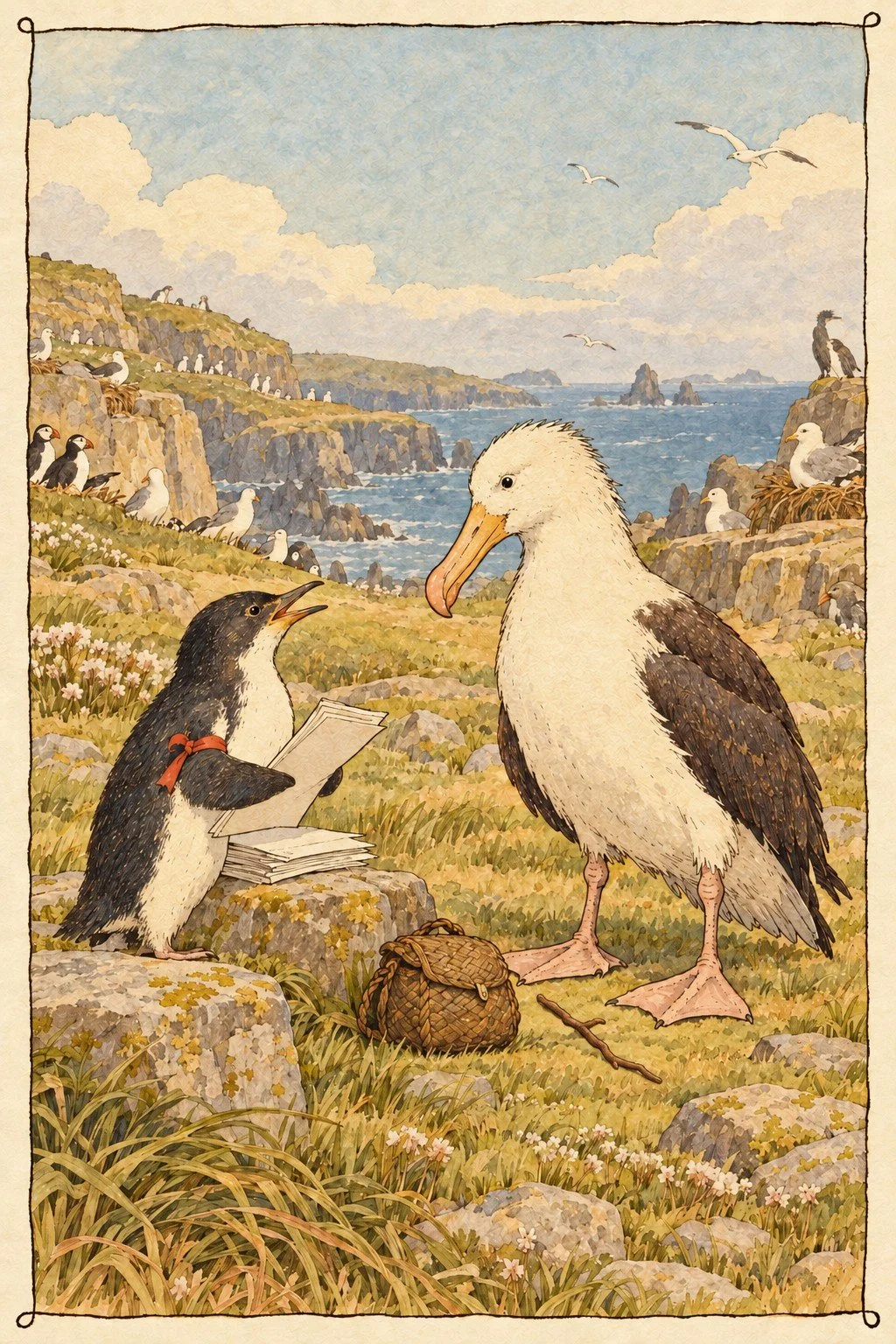
Jack looked around.
“What kind of colony is this?”
Millicent appeared surprised.
“A normal one.”
Jack looked at her papers.
“Do normal colonies require this much documentation?”
“No,” Millicent said proudly. “We have improved normal.”
Jack decided not to ask what was on page three.
While Millicent filled out the first two, he told her why he had come. She added a small box marked LIGHTHOUSES.
Jack soon discovered that the colony contained many arrangements.
Two birds nested together but migrated separately. Three old friends shared a nesting area and argued constantly about fish. One pair spent every winter together and every summer on opposite sides of the ocean. Another pair had once been mates and were now simply friends.
They seemed surprisingly comfortable about this.
Jack had never seen anything like it.
Millicent attempted to explain.
“Not every meaningful relationship has to perform the same function forever.”
Jack frowned.
“But if it changes, doesn’t that mean it failed?”
Millicent looked genuinely puzzled.
“Does a sunrise fail because it becomes morning?”
Jack had not expected paperwork to include sunrises.
Millicent continued.
“Some things end. Some things change. Some things stay. Meaning is not awarded only to things that last forever.”
Jack disliked this idea. Not because it was obviously wrong. Because it threatened one of the few things he still believed.
Jack had always thought permanence was proof. If something lasted, it mattered. If it ended, perhaps it had not mattered enough.
Millicent’s colony suggested otherwise. This was inconvenient.
The most useful ideas often are.
Millicent eventually finished her forms. This took considerably longer than seemed necessary.
“You’ll need somewhere to eat,” she said.
“I can find food.”
“I did not say you couldn’t.”
Millicent pointed toward a cluster of albatrosses gathered farther along the cliff.
“Communal supper. Visitors are expected to bring a fish or an interesting question.”
“I don’t have an interesting question.”
Millicent looked at him.
“You crossed an ocean carrying a twig to find a lighthouse that supposedly explains why your mate left.”
Jack considered this.
“I may have one.”
He slipped the satchel back over his head, picked up the twig and went to find a fish.
Jack brought a fish. He arrived with the fish clamped in his bill above the twig. His satchel bumped his breast at every step. This arrangement was neither graceful nor sustainable.
At the edge of the gathering, an albatross with a pale gray streak over one eye watched him struggle.
“You could put one of those down,” she said.
Jack placed the fish on the ground and shifted the twig to the corner of his bill.
“The other one,” she said.
Jack looked at the twig.
“No.”
The albatross laughed before Jack could decide whether she was teasing him. Her name was Celeste.
Celeste collected questions. Not answers. Questions.
Around her nesting spot were dozens of shells, each marked with one. Where does the wind go when it stops? Can you miss a place you have never been? Why do gulls shout when everyone can already hear them?
Jack read the last one twice.
“That is a very good question.”
“I’ve been researching it for years,” Celeste said.
“Any conclusions?”
“Several. None flattering.”
Celeste moved aside and made room for Jack at supper. He placed the twig beside him so he could eat. Celeste glanced at it.
“What’s that?”
Jack sighed.
“Long story.”
“I prefer those.”
So Jack told her. The nest. Sadie. The way she left. The twig. The heron. Beatrice. Pip. The Lighthouse of Exact Reasons.
Celeste listened without interrupting.
Jack was beginning to understand how rare this was.
When Jack finished, Celeste asked:
“Do you still love her?”
Jack looked at the twig.
“Sometimes.”
Celeste nodded.
“And do you want her back?”
Jack opened his bill. Then closed it. Then opened it again.
“I don’t know.”
Celeste smiled.
“That sounds more interesting than yes or no.”
Jack glanced in my direction.
I exercised admirable restraint.
“You’re very proud of yourself, aren’t you?” he said.
Some restraint deserves recognition.
Jack and Celeste talked until the moon rose. They talked about travel. Bad weather. Families. The strange habits of gulls.
Celeste told Jack about a year she had spent following an ocean current simply because she wanted to know where it went.
“Where did it go?” Jack asked.
“Mostly north.”
“That’s it?”
“That’s it.”
“And was it worth it?”
Celeste grinned.
“Completely.”
Jack laughed.
At some point during supper, Jack realized he had stopped looking at the twig. It lay beside his foot.
He had not forgotten Sadie. He had simply been interested in someone else. This surprised him. Then worried him. Then surprised him again.
Jack picked up the twig. Celeste noticed.
“You don’t have to apologize to it,” she said.
“I wasn’t.”
“You looked like you were about to.”
Jack put it back down.
Jack stayed in the colony for several days. He ate with Celeste twice more. They walked along the cliffs. They watched seals quarrel over a rock no seal particularly needed.
They argued about whether clouds could look judgmental. Celeste believed they could. Jack believed this was projection. The clouds declined to clarify their position.
Jack liked Celeste. This frightened him more than he expected. Not because she reminded him of Sadie. She did not. Because she didn’t.
Jack had spent so long believing that love had one shape that encountering another kind of connection felt almost disloyal.
This is one of grief’s quieter tricks. It can convince you that making room for something new requires removing what came before. It does not.
On Jack’s final evening in the colony, Celeste asked:
“Will you come back?”
“I don’t know.”
“Good.”
Jack laughed.
“You like that answer.”
“It’s an underrated answer.”
Jack looked at her.
“What if this is the last time we see each other?”
Celeste considered the question.
“Then I’m glad we had supper.”
That was all. No promise. No prediction. No attempt to turn three dinners into destiny.
Jack found this unexpectedly beautiful.
The next morning, Celeste walked with Jack to the cliff. Below them was open ocean again. The lighthouse lay somewhere farther east.
At least according to Maurice. Which remained an alarming qualification.
Celeste touched her beak gently to Jack’s.
“Safe travels.”
Jack looked back at the colony. At Millicent and her forms. At the strange assortment of nests and non-nests. At Celeste.
Sadie had mattered. Pip had mattered. Bernadette had mattered. Celeste mattered.
Not all important things stay. That does not make them less important.
Jack opened his wings and flew east over the sea.