Chapter 8 of 10
A Detour
Jack left the lighthouse and flew west across the open ocean. Maurice’s map suggested that he retrace his route precisely. Jack had developed sufficient judgment to ignore Maurice’s map.
For most of the morning, he let the wind carry him west. Then he saw a small island several miles to the south. It was nowhere near the route home. Jack turned toward it. This constituted what one might properly call a nonteleological deviation.
“A what?” Jack asked.
A journey undertaken without a predetermined objective.
“You mean a detour.”
That is a regrettably pedestrian way of putting it.
“It’s a detour.”
Very well.
Jack took a detour.
Once, long before Sadie, Jack had loved detours. He would follow an unfamiliar wind simply to see where it went. He would circle islands that were not on his route. He would fly toward distant shapes because he wondered what they were.
Sometimes they were interesting. Sometimes they were rocks. Jack had enjoyed both.
Sadie was different. Sadie liked destinations. She liked plans. She liked knowing where they were going and, whenever possible, when they would arrive.
Over the years, Jack had become more like her. He had not minded. Mostly.
But as he turned toward the little island, Jack felt something old and familiar stir inside him. He had nowhere he needed to be. Jack felt a flicker of excitement.
The island was little more than a pile of black rocks with grass growing in the cracks. Dozens of rockhopper penguins lived there. They had yellow feathers above their eyes that gave them the appearance of being permanently astonished.
On the day Jack arrived, the penguins were holding their annual pebble competition. Jack did not know that pebble competitions existed. This was because, until that morning, they had not mattered to him.
The competition was overseen by a rockhopper named Percival. Percival had exceptionally large yellow eyebrows, even by rockhopper standards. He spoke in a whisper. Nobody knew why.
“Welcome,” Percival whispered.
“Thank you,” Jack whispered back.
“You do not have to whisper.”
“Oh.”
Percival led him toward a row of twelve pebbles displayed on a flat rock.
“This is the final round.”
“The final round of what?”
Percival looked shocked.
“The pebbles.”
Jack inspected the finalists. There was a round pebble. A flat pebble. A reddish pebble. A pebble with a stripe. One that looked vaguely like a potato.
Percival pointed to the striped one.
“Excellent symmetry.”
Jack nodded.
Percival indicated the reddish one.
“Superior mouthfeel.”
Jack stared at him.
“You eat them?”
“No.”
“Then why—”
“Please respect the judging process.”
For reasons Jack never fully understood, he was appointed guest judge. He selected the potato-shaped pebble. The crowd gasped.
Percival whispered:
“Explain.”
Jack considered the pebble.
“I like it.”
There was a long silence. Then the penguins erupted in applause. Apparently, no judge in the competition’s history had considered this criterion.
The potato-shaped pebble won.
Jack remained on the island until morning. He ate fish. He listened to arguments about stones. He watched Percival disqualify a pebble for “excessive ambition.”
He laughed considerably more than seemed warranted.
Nothing important happened. No revelation occurred. Jack learned nothing about Sadie. He learned nothing about himself. There was no lesson.
I searched diligently for one.
“Don’t,” said Jack.
So I won’t.
The next morning, Jack flew north until the little island disappeared behind him. Then he turned west again over open sea.
He had added nearly a full day to his journey. This did not bother him.
Once, before Sadie, Jack had often traveled this way. No schedule. No great purpose. No particular need to arrive.
With Sadie, life had acquired more direction. Jack had loved much of that too. Plans had taken them extraordinary places.
But somewhere along the way, Jack had forgotten that wandering could also be a way of traveling. He was beginning to remember.
For several days, Jack flew west. He rested at night on the water. He caught fish. He followed currents because they interested him.
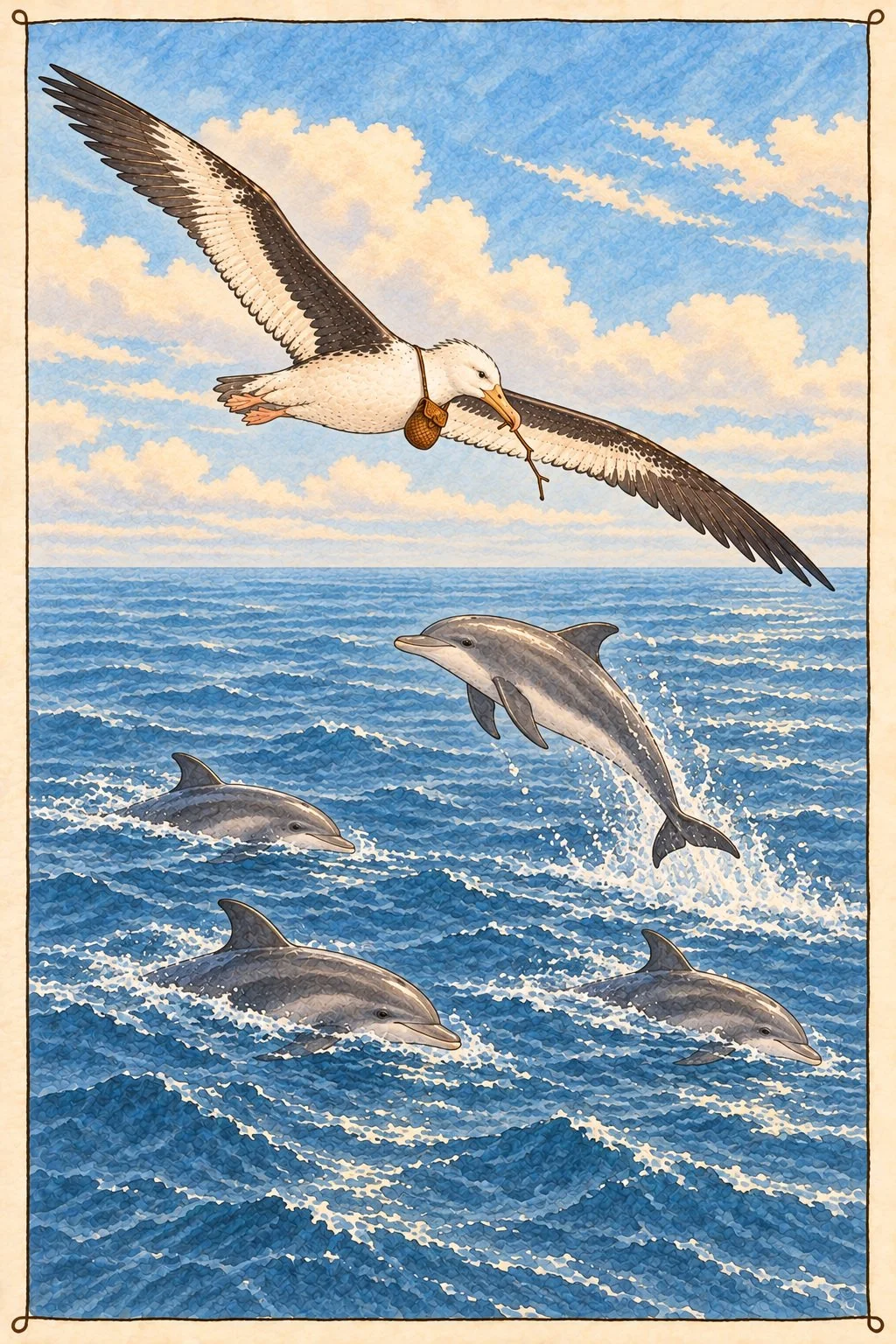
Once, he flew beside a pod of dolphins for nearly an hour simply because they appeared to be having an excellent time. That evening, floating alone beneath the stars, he remembered one dolphin’s spectacularly unnecessary leap and laughed. He had no one to share the joke with. For once, this did not seem to make it a lesser joke. He found he liked his own company.
He was no longer traveling in search of an explanation. He was traveling because the world was large. And because, increasingly, he wanted to see it.
Jack had not become someone new. In some ways, he was becoming reacquainted with someone old.