Chapter 5 of 10
Across the Ocean
The next morning, Jack left the island.
He flew west at first, back toward the mainland coastline. Then he followed the shore south for most of the day. The land gradually narrowed. Mountains fell away behind him. By late afternoon, Jack landed on a ledge and unrolled Maurice’s map.
It offered only one remaining instruction:
CROSS OCEAN HERE.
Below it, Maurice had drawn another fish.
Jack was beginning to suspect Maurice had misunderstood cartography.
Ahead of Jack was open sea. A great deal of it. No islands were visible. No coastline waited on the horizon.
The lighthouse, if it existed at all, lay somewhere far beyond what Jack could see.
He rested that night on the water. Albatrosses can do this. They fold their enormous wings, settle onto the sea and float.
It is less majestic than flying. Most resting things are.
Jack bobbed gently beneath a sky full of stars. For the first time in months, no one was asking him questions.
He found this pleasant.
The next morning, Jack flew. And flew. And flew.
There are passages in every great adventure during which surprisingly little happens. Authors generally disguise these with phrases such as:
After many arduous days ...
or:
Across immeasurable distances ...
because writing:
Jack flew for eleven hours and saw mostly water
lacks grandeur.
“It is more accurate,” said Jack.
Accuracy is not always literature.
“That explains quite a lot.”
On the third day over the open ocean, Jack met a storm petrel. She was so small that Jack initially mistook her for something the wind had dropped. Her name was Pip.
Pip flew as though she had somewhere extremely important to be. She did not. She simply preferred urgency.
“You are going the wrong way,” Pip announced.
Jack looked around. There was ocean in every direction.
“The wrong way to where?”
Pip thought about this.
“That depends.”
“On what?”
“Where you’re going.”
Pip was dark brown, with a white patch above her tail and feet that seemed forever to be catching up with her. She was fast and incapable of maintaining a single subject for more than several minutes.
She knew seventeen kinds of wind. She distrusted calm water. She had once followed a ship for nine days because someone aboard dropped excellent crumbs. She also asked questions without waiting for permission.
“What’s the twig?”
Jack tightened his bill around it, then shifted it to one corner so he could answer.
“A keepsake.”
“From what?”
“My old nest.”
“Why are you carrying it?”
Jack stared at her.
“Do all storm petrels ask this many questions?”
“No,” said Pip.
Then she added: “Some ask more.”
Pip decided to travel with Jack. She did not ask. She simply began flying beside him.
Jack flew high above the waves, using the great ocean winds to glide. Pip darted below him, above him and occasionally directly in front of his face.
“You fly very straight,” Pip said.
“Thank you.”
“It was not a compliment.”
Jack looked toward me.
I said nothing.
Some moments require restraint.
For two days, Jack and Pip flew east across open ocean. There was no land in sight. Only water. Sky. Wind.
And Pip. Especially Pip.
She talked about storms. Fish. Ships. Clouds. A disagreement she once had with a tern. A piece of bread she considered life-changing. And whether the moon looked larger when no one else was watching.
Jack listened. Mostly because talking with a twig in his bill remained inconvenient.
Eventually Pip noticed this.
“You could put that down.”
Jack looked at her.
“We are flying over the ocean.”
“Oh.”
Pip considered the logistical problem.
“Yes. That would be unfortunate.”
Jack appreciated this.
It was the first advice about the twig that had taken gravity into account.
That afternoon, the wind weakened. Then weakened again. Then stopped almost entirely.
Jack circled lower until his feet touched the water. Pip landed nearby. For several hours, they floated on the open sea.
Jack disliked this. Pip loved it.
“You said you distrusted calm water,” Jack reminded her.
“I do. It is being unusually persuasive today,” said Pip.
“Nothing is happening,” Jack said.
“Exactly.”
“And you enjoy that?”
“Very much.”
Jack looked around at several thousand miles of water.
“You are strange.”
“Thank you.”
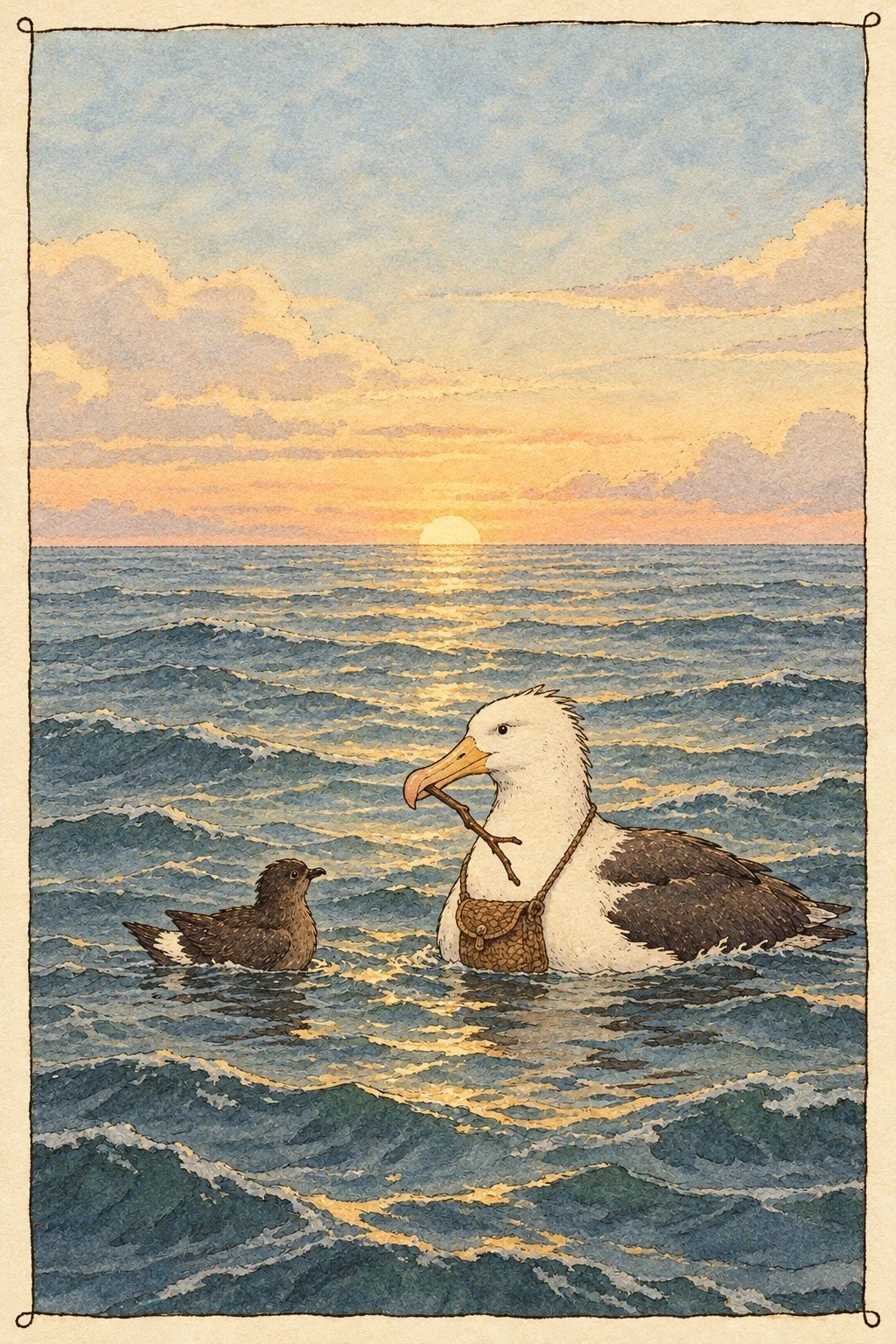
The sea rose and fell beneath them. No land was visible. No boats. No gulls offering advice. No herons asking questions. No kakapos suggesting personal growth.
Jack floated. Pip floated.
For once, Jack did not try to understand anything. This was unexpectedly difficult. Then, gradually, it became unexpectedly peaceful.
There are moments when doing nothing is not avoidance.
It is simply doing nothing.
The sentence lacks rhetorical splendor.
Jack insisted it stay.
Near sunset, a low sound rolled through the water. Then another. Then another.
Pip lifted her head.
“Whales.”
Jack listened.
The calls rose from somewhere beneath them. Long. Deep. Mournful. Beautiful.
“They’re singing,” Jack said.
Pip tilted her head.
“No.”
“No?”
“They’re doing a program.”
Jack stared.
“A what?”
Pip sighed.
“You’ll see.”
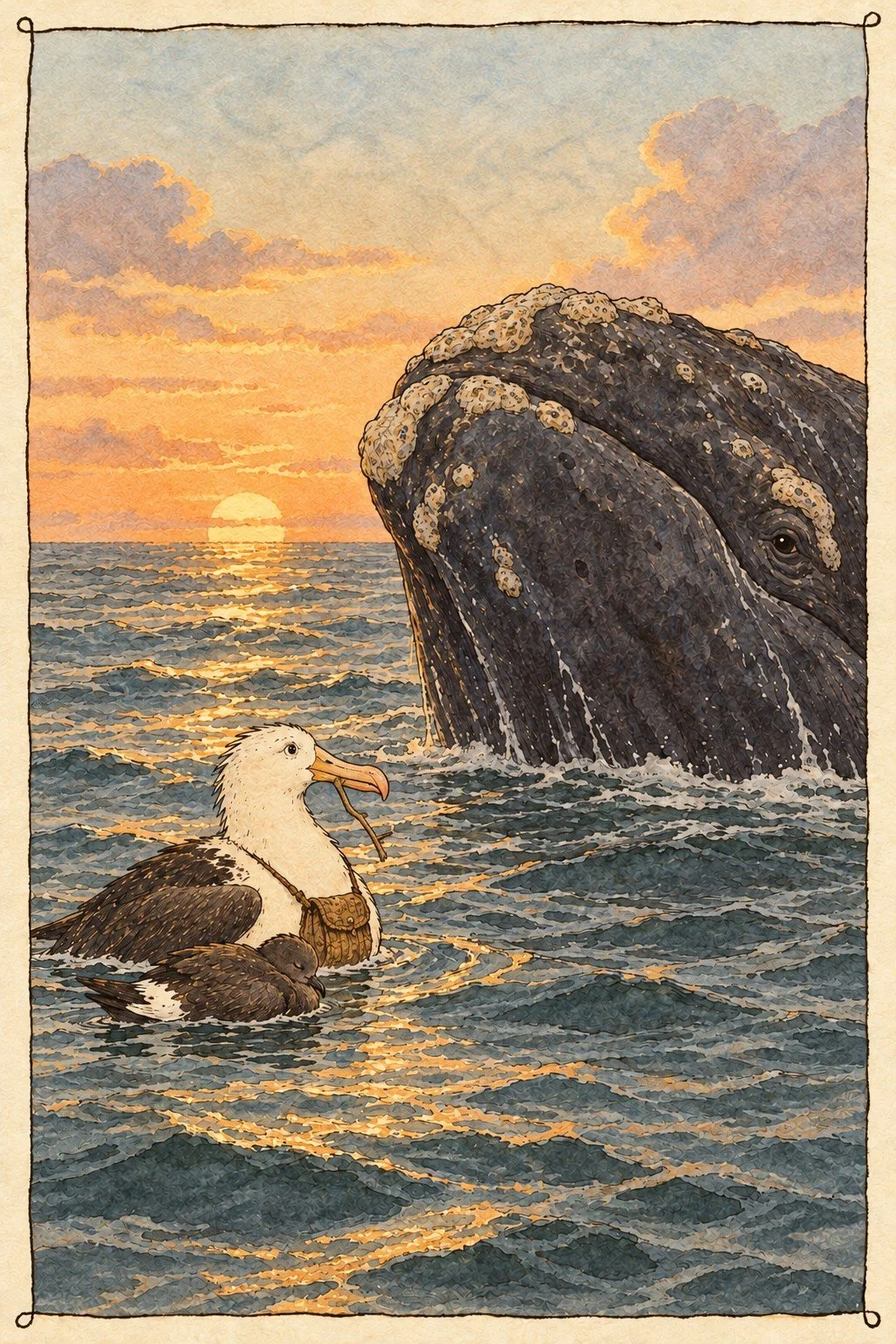
An enormous southern right whale surfaced nearby. His name was Barnaby. Pale, knobbly patches crowded his enormous head. Barnaby had a magnificent voice and an almost supernatural inability to summarize.
He greeted them warmly. Then he said:
“Today I would like to explore the seventeen essential stages through which a creature must pass in order to achieve authentic emotional integration.”
Jack looked at Pip.
Pip whispered: “I warned you.”
Barnaby continued. Stage One involved awareness. Stage Two involved becoming aware of awareness. Stage Three involved recognizing that one had previously been unaware of awareness. Stage Four required something called intentional aquatic presence.
Jack stared at an empty patch of water. Pip fell asleep.
Barnaby spoke for nearly an hour. Then he paused.
Jack opened his bill wider to ask a question. The twig fell into the water. Jack lunged forward and caught it before it sank.
Barnaby waited patiently.
Pip woke up.
“What did I miss?”
“Stage Four,” Jack said.
“Again?”
Apparently Barnaby returned to Stage Four often.
When Barnaby finally finished, the sun had set. Jack was exhausted. Pip was hungry. Barnaby looked pleased.
“Did you find that useful?” the whale asked.
Jack considered lying.
Instead he said: “Some of it.”
Barnaby nodded.
“The rest will become clear when I explain it all again. From Stage One.”
Pip immediately took flight. Jack followed.
The wind returned during the night. Jack and Pip flew beneath the stars. Something felt different. Jack was not thinking about Sadie.
This realization caused him to think about Sadie. Then he became annoyed with himself for ruining it.
Pip noticed.
“You’re frowning.”
“I forgot to be sad.”
“Is that bad?”
Jack thought about it.
“No.”
“Then why are you frowning?”
Jack had no answer.
The next morning, they passed a floating crate. Pip insisted they investigate.
Inside were six damp books and a sheet of oilskin. One was a slim book about navigation. One was about fish. One was a collection of romantic poetry. Two were missing their covers. The last was titled:
BECOME YOUR BEST SELF IN SEVEN TIDES
Jack groaned. Pip opened it.
“Chapter One: Identify Your Limiting Currents.”
“Throw it back,” Jack said.
“You haven’t read it.”
“I’ve met Barnaby.”
Pip threw it back.
Jack kept the navigation book. He wrapped it in the crate’s oilskin and tucked it into his kelp satchel beside the shell and Maurice’s rolled map. The twig stayed in his bill.
For several days, he read pieces of it whenever he rested on the water, propping it against his satchel and tucking the twig beneath the cord. When he finished, the book went back into its oilskin and the twig into his bill.
He learned about currents he had never followed. Islands he had never visited. Winds that crossed entire oceans.
Jack began imagining routes Maurice’s map had left out. Not because they might explain Sadie. Because they sounded interesting.
This was new.
Recovery sometimes announces itself dramatically. More often, it appears as curiosity about something that has nothing whatsoever to do with your pain.
One afternoon, Pip spotted a ship.
“Race you,” she said.
“To what?”
“The ship.”
“Why?”
“So I can win.”
Jack laughed.
Then Pip flew. Jack followed. The ship was much faster than either of them expected. For nearly an hour they chased it over open water. They simply had fun.
The episode was deficient in hermeneutic profundity.
“You mean we had fun,” said Jack.
I suppose so.
That evening, Jack realized something. He had laughed twice that day. Neither time had surprised him.
This made him unexpectedly sad. Once, Sadie had been the bird who made him smile most easily. Whenever they laughed together, he had been filled with joy.
Jack floated silently on the water. Pip landed beside him. She did not ask what was wrong. She simply stayed.
Jack was beginning to understand that happiness did not replace grief. Sometimes they sat beside each other.
Several days later, a line appeared on the horizon. Land.
Jack and Pip had crossed farther than Jack had ever traveled alone.
The distant coast rose slowly from the sea. First mountains. Then dark cliffs. Then a thin strip of green.
Jack felt something stir inside him. Not relief. Not sadness. Something closer to anticipation.
Pip noticed.
“You want to see it.”
“Yes.”
“So go see it.”
Jack increased his speed.
Before they reached the coast, Pip slowed.
“This is where I turn north,” she said.
Jack slowed too.
“You’re leaving?”
“Yes.”
“Why?”
“Because I’m going north.”
Jack waited. Pip waited. There was apparently no deeper explanation.
“When will I see you again?” Jack asked.
“I don’t know.”
Jack felt the old ache rise. Pip saw it.
“I’m not disappearing, Jack.”
“I know.”
“I’m telling you where I’m going.”
“I know.”
“And you didn’t do anything wrong.”
Jack smiled.
“I know.”
This time, he meant it.
Pip flew north. Jack watched until she became a speck against the sky. Then the speck disappeared.
He missed her immediately.
But the feeling was different. There was sadness. There was gratitude. There was no frantic search for what he had done wrong.
Jack turned toward the distant coast. For the first time since Sadie left, someone had left him and he remained entirely himself.